In my youth, my two aunts who had never married and spent much of their free time traveling all over the world, had regularly given me bills and coins of foreign currencies. Later, when my brother started traveling he also kept paper bills for me. This continued with my own travels. Whenever I came across nice looking notes, I would try to find one in good condition and keep them in a book to add to my ever growing collection back home. I would also pick some up now and then if I came across some coin and stamp collection shop that had some interesting bank notes.
Don Quixote on a Spanish Peseta
What I love about paper money from different countries is that they are a reflection of each country's history, culture, environment or politics. Also, they keep changing them every ten years or so (sometimes faster if there is a huge devaluation of a currency). On the other hand, some countries have joined forces for one single currency. Unfortunately for my collection, the Euro has eliminated over a dozen such classic currencies as the franc, the mark, the peseta or the lire. This has also happened in parts of Africa. Conversely, with the disappearance of the Soviet Union, a dozen new currencies were created. There are many similar themes on bank notes. Often, in developing countries, you see imagery of progress with pictures of tractors or industry. Others would be historical or political personalities. Images of local flora and fauna is also very common. I have some bills with long gone strongmen and tyrants such as Idi Amin Dada or Saddam Hussein. Some bills are very colourful, others more classic in design. Others include the latest technologies to prevent counterfeiting. Here is a sample of various bills that I really like from the beginning of the twentieth century right up to recent times.
German marks from the 1920s
Greek drachma, 1944
Beautiful bills from Hungary. top 1941 bottom 1952
Two more Hungarian forint from the 1990s
Irish pounds before the Euro. This series of bills has some great calligraphy.
20 Francs, 1942
The last series of the Franc before the Euro, with a great ode to Antoine de Saint-Exupéry and "Le Petit Prince"
I love the simplistic graphics of this 1991 bill from Lithuania
a 1909 bill from Russia
A heroic figure from the Ukraine
Georgia 1990s
10 Kroner - Denmark, 1936
50 Lire - Italy, 1951
The next series of currencies are from Asia. The Chinese and Japanese ones are from the 1930s. I also included a few bills from French Indochina in the 1940s which have a typical "orientaliste" theme of native culture as seen through the eyes of Europeans. Two bills from Cambodia reflect different political climates, one from the independent 'Royaume du Cambodge', the other from Pol Pot's Khmer Rouge communist regime in 'Kampuchea'.
China 1935 (top) and 1930 (bottom)
China 1953
Japan 10 yen
Cambodia 1970 with Angkor Wat's famous temples and Khmer Rouge's revolutionary Kampuchea 1975
Two bills from North Korea, with the 'Great Leader' Kim Il Sung
I like this small, simple note from Indonesia 1964
Burma, 1970s
an unusual square commemorative note from Thailand
Nepal, 1990s
40th anniversary of the creation of Bangladesh after it's war and succession from Pakistan
Beautiful Islamic patterns on these notes from Uzbekistan
A traditional outrigger canoe from the South Pacific island state of the Cook Islands
Tahiti 1970s
Acknowledgment of Aborigines' culture on this commemorative Australian 10 $ note
Next are the Americas, Africa and the Middle East. When I was a kid, the colourful Canadian bills with a young Queen and classic Canadian wilderness scenes on the back were my favourite bills. I included the greenback from the USA. For all its importance as a global currency, it is one of the most traditional and classic notes which, up until recently, has barely changed at all in its design and appearance.
A series of this 20$ bill has a "demon" in the Queen's hair. Do you see it?
As an avid kayaker, I love this scene of Inuit with their traditional boats.
"Real money is green" I once heard an American say. I do like their classic one dollar bill,
even if they should discontinue it and turn it into a coin.
One of the few bills from Cuba that show Fidel Castro
Nice symmetry of this 5 cruzeiros bill from Brazil (top) and an acknowledgement of indigenous peoples in a later,much inflated cruzeiro of the 90s.
Classic bank note from Chile, 1961
No shortage of cultural imagery, fascinating portraits and geography for currencies from Africa.
The colonial and post-colonial bills are often colourful and represent daily scenes of people
or animals.
L'Afrique Occidentale Française et Togo, 1956
États de l'Afrique équatoriale, 1963
L'Afrique Occidentale, 1941
Belgian Congo, 1953
Banque de la République du Mali, 1960
Cameroon, 1962
The "leopard of Africa" Mobutu Sese Seko, the long standing dictator of Zaire
Idi Amin Dada's Uganda 1970s
Guinée, 1960
The hyper-inflated note ( ten billion! ) of Mugabe's Zimbabwe
Education, a common theme on bank notes, this one from the ever-reclusive state of Eritrea.
An Ethiopian 100 dollar bill during Emperor Haile Selassie's reign, with his classic "Lion of Judah" symbol. 1960s.
Egypt, 1940
Muammar Gaddafi's Libya, 1980
Shah's Iran, 1970
A 1990s Iraqi bill with Saddam Hussein
One Riyal, Saudi Arabia
"dix livres" Banque du Liban
One shekel, Israel, 1958
Turkey, 1970. One of the few bills that do not have the omni-present portrait of Ataturk (founder of modern Turkey) but rather a nod to their Ottoman past depicting one of the Sultans.
Currency and paper money are fun to alter in an artistic sort of way. Here are a few examples of some that I have done.
On the August long weekend, Irene, Carlos and Carolina and I went for a three day hike to the popular Garibaldi Provincial Park. I had not done a camping hike trip for many years and I found that the equipment I had... tent, sleeping bag, cooking pots were heavier and bulkier than I would have liked. My old back pack was completely full. We left early Saturday morning and arrived at the parking lot just after 8:00 and it was already almost full. It was a three hour hike zig zagging up a steady slope in the typical coastal forest full of tall cedar and douglas fir. We had decided to stay at Taylor meadows camp spot as it was closer to the alpine hikes than the camp spot at Garibaldi lake. Also, all three had been to the lake before. I was the only one who had not done this hike. Irene and I were a bit slower and met up with Carlos and Carolina there.
We found a nice spot to put the tents right by a fast running stream. Better, I thought, than the tent pads of wooden planks that were the official spots. After setting up camp and cooking lunch, we continued uphill (free of heavy backpacks) through the meadows and eventually to the alpine region and on to the "panorama" trail. It was a spectacular view of Garibaldi lake. It was a hot day and pretty tiring as it was just over 20km of walking. I was surprised by the amount of mosquitos, deer flies and horse flies that were happy to be feasting on all the hikers. This is a very popular hike so it was no surprise that the trails and campgrounds were full of people, either staying a couple of nights like us or just for a day hike. On the way down from the panorama, Irene and I decided to go part way down on the snow. It was pretty funny slip sliding down, but better than going downhill on all the sharp shale rocks on that part of the mountain. Across the valley was a great view of the black tusk where we were going to go the following day.
The next morning after a breakfast of eggs we hiked back through the meadows and this time took the fork toward the black tusk. It was another hot summer day with clear skies. Luckily it was windy once we got higher up which helped somewhat with the feasting insects. At the end of the trail, we had a great lunch of avocado, sprouts, tomatoes, salami and bread, with a view of the panorama mountain we had hiked the day before. Irene and I decided to stop at the end of the trail while Carlos and Carolina were going right to the base of the tusk and, we found out later, climbed right up onto the summit. After hearing their adventure on the summit I sort of wished we had gone too however, I was having foot issues with a new pair of hiking boots and we both wanted to take it a little easier that day. Back down at the tent by late afternoon and taking a nap, we were awaken by the ranger who told us we had to move the tent as it was not an official spot. That was unpleasant. Carlos and Carolina made it back by nightfall and joined us after I had left a map indicating where we were now camped. The next day we packed up and left after a breakfast of pancakes. It was a nice weekend getaway. Going back down I could not believe the amount of hikers going up for the the day, the holiday Monday. On the drive back, we were already thinking of the ramen noodles we were going to have at a neighbourhood restaurant.
I finally cleaned out the Manta Ray of all the tools, paint, epoxy and stuff I had in the boat to fix small problems that had still needed to be addressed after putting her back into the water in mid-July. I did get in quite a few day sails in English Bay during the summer. However, now was the time to go beyond the waters of Vancouver and enjoy the boat for more than a few hours at a time. I brought in the sleeping mattresses and supplies, food, water and was set to go for a week of sailing.
I was headed to my friends Erik and Naomi's wedding on the island. A mutual friend Kevin and his girlfriend Malika were also going so I had invited them to come on board. Kevin, a Nova Scotian, is a sailor so he was game to get to the island by sailing a T-bird, a boat he also once co-owned and had sailed a lot. As I am still not totally confident to sail across the Georgia Straight alone, it was good to be with someone. We set out with light wind directly out of the west, the direction we were going. After tacking for a couple of hours it was apparent we were going nowhere fast (Spanish Banks to be exact) so I started the motor. The wind dropped completely and the water was calm. Time enough to learn all about the hand held GPS I had bought. Four hours later we crossed the Straight and came into Silva Harbour, just as the sun set. It's a beautiful harbour protected by a few small islands at the southern end of Gabriola island. We dropped the hook, had some curry Malika had prepared with rice and watched the stars come out.
The next morning the wind was blowing from the Northwest, again in the direction we were headed, but this time at around 15 + knots. Once out of the harbour the waves were already over three feet high. It was going to be a bit of a slog beating up wind, which we did for over three hours tacking back and forth. Poor Malika got sick a few times but she was a pretty good sport about it. I was hoping we would get to Nanoose Bay, north of Nanaimo, but that was not going to happen. Once we passed Entrance island and headed toward Nanaimo harbour, we were on a beam reach and we were cruising nicely at 6 to 7 knots, the waves cascading under us and with a quieter wind. That is when you realize that all the work you have done pays off for that feeling of freedom while sailing your boat.
We sailed right into the harbour and dropped the anchor next to Protection Island. During the sail over, when the boat was heeled over pretty good, I noticed a lot of water in the bilge sloshing about. What would a trip be without some sort of mishap? Water was gushing out from just below the sink where the hose leading to the thru-hull was clamped to the bottom of the sink. It was corroded. There is no one way valve, I learned, in that hose so the pressure of the water when the boat was heeled over on that side made it come out. I cut the hose, stuffed it with a rag clamped and ducked taped it as a temporary repair.
Coming
into a harbour, it's always great to check out the other boats anchored
around you. We got in the dinghy and went for a little tour.
Scottish wooden boat (it had the year 1939 written on it)
a beautiful Dragon keelboat (Norwegian design from the 30's)
a Chinese Junk (traditional 'eyes' at the bow)
After a gorgeous weekend on a farm for a wonderful wedding, it was back on the boat. This time I had another friend, Mona, on the boat. She had a few days off, had never been on a sailboat and was willing to come with me up the island and across to the Sunshine Coast. Well that was the plan... By the time we left, it was already 1:00pm and the winds were again NW, the direction I wanted to go. I was hoping to cross the Straight to Lasqueti Island, but then there was something I had not known about... a sectioned off area in the Georgia Straight (on the chart) where the Navy does War Games. It's called Whiskey Golf (WG), and you need to listen to the radio, to see if they are active of not. You can only sail through if they are not doing their manoeuvres. Well my battery was low and I could not even pick up the weather forecast very clearly. So change of plan, we headed with the wind back to Silva Bay, spent another beautiful evening, had a beer at the local pub and dinner on the boat.
Silva Bay, Gabriola Island
The winds the next morning were favourable to cross so I decided to return to Vancouver, where Mona got off. The next morning left again, this time with Albert, whom I had promised a few days sail for all the work he did on my boat. We set off for Howe Sound, with a nice breeze that brought us to the lighthouse at Atkinson Point in West Vancouver before the wind dropped. Tried some fishing with no luck. Then we motored to Snug Cove on Bowen Island, tied up at the dock and had a look around. Nice small harbour tucked in a few steep slopes. As I am looking for winter moorage I asked about the prices and availability. There may be a spot opening up at the end of October.
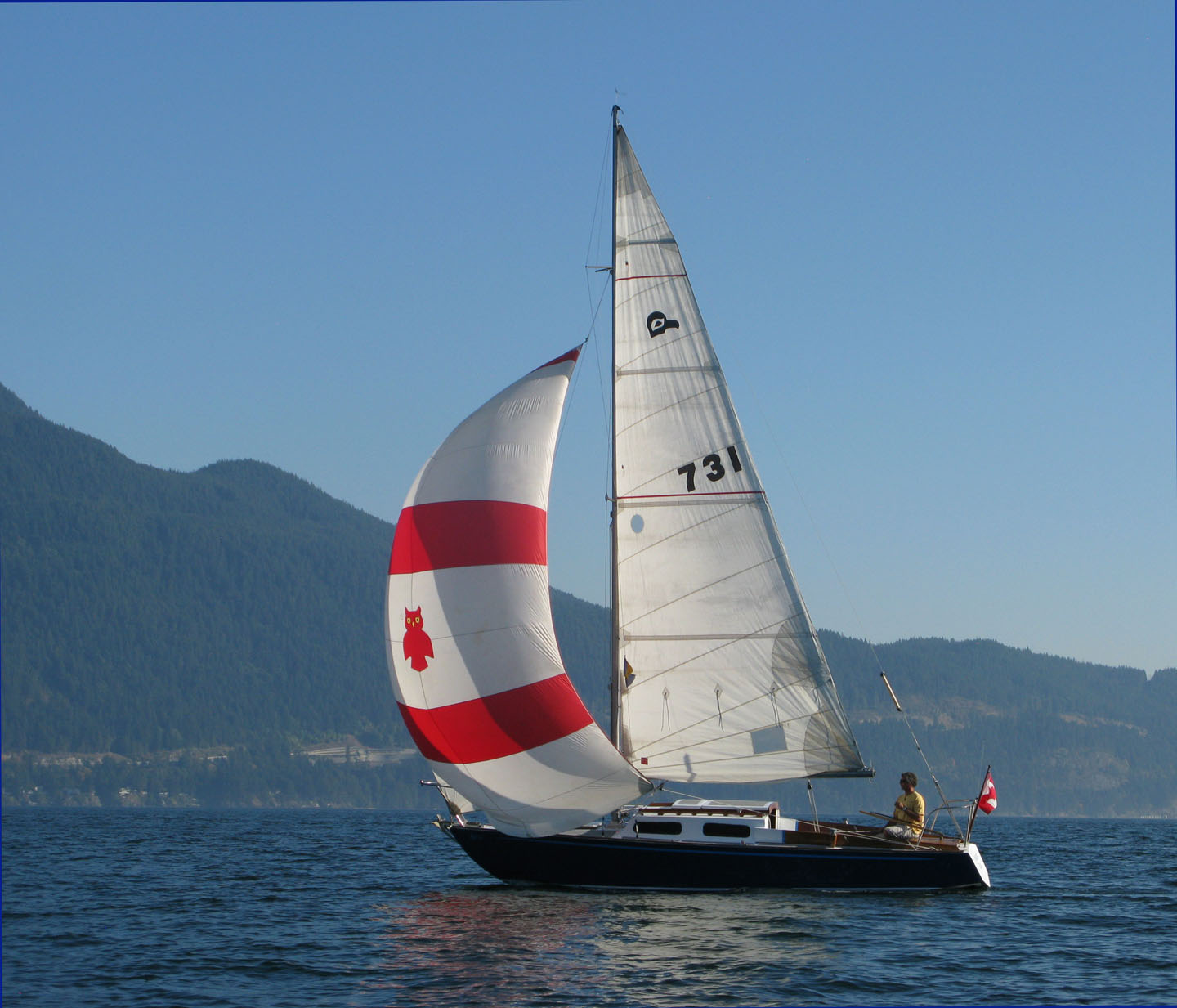
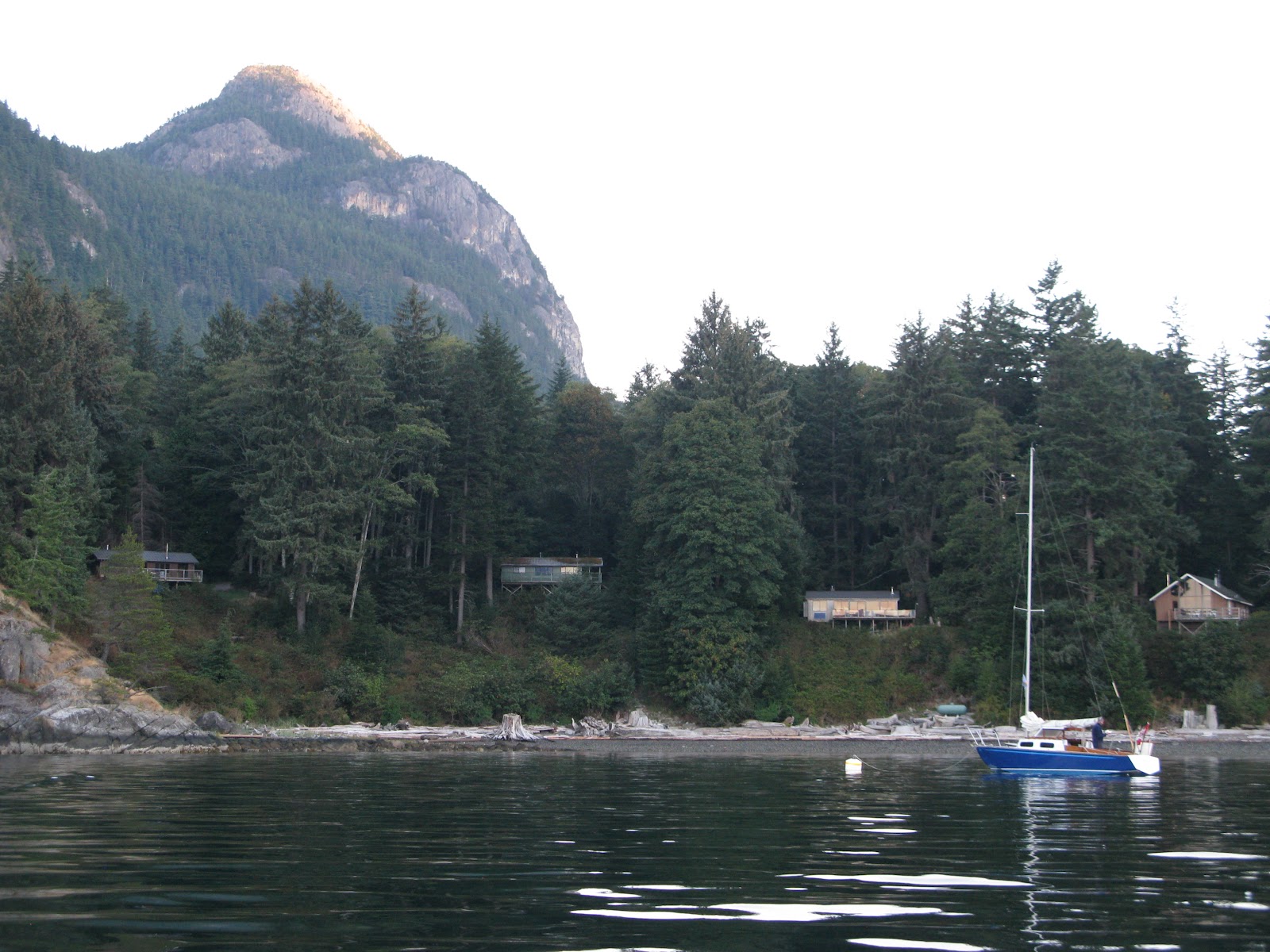
We left the cove and the wind picked up, and in our backs, so we put up the spinnaker. I don't have a pole, so we just used it like a jib. It's a nice sail that Albert gave me, a small tear that needs repair, but it still went fine. A beautiful sunny day, we cruised up to Anvil Island, where there were a few empty mooring buoys that you can just tie on to. A relief to see as anchoring in bays with depths that drop dramatically is not only difficult, but stressful.
Another sunny morning and we left toward the Sunshine Coast. The breeze was light enough that with one sail up, I was able to fish next to some islets rocks, home to a seal colony. Only caught one, a "big one" that snapped my line... The wind picked up and we sailed along Gambier island, some nice rock walls and cliffs, then on past Keats Island and into Gibson's Landing where we dropped anchor in a large bay amongst several other boats. Checked out the town as well their marina which, of course, had an interesting array of boats. Had some excellent fish tacos from a food stand on the pier.
another Dragon
The following morning it was cloudy for the first time in weeks and the wind was blowing a good 15 to 20 knots, this time from the S.E. In the fall, it tends to be from the N.W. which it had been all week. Those North-Westerlies we were hoping to have for a quick sail with the wind in our back became another tacking adventure beating upwind into big waves going around the outside of Bowen Island in the Georgia Straight. It took us six hours in total to sail back but that was nice as the motor was barely used. The toe rail was buried in the water a lot of the time and waves splashed on the jib. Exciting. I docked the boat at Granville island to get my car and unload the gear before anchoring out at Kits' Point. All in all a great first sailing trip with the Manta Ray.
After three and half months of working on 'Manta Ray', my T-bird sailboat, she is finally back in the water. As any boat owning person understands, there was much, much more work to be done than anticipated. I had her out of the water in Shelter Island boat yard for the winter. Periodically, I would check her out and noticed water in the bildge. I couldn't really figure out where the water was coming from, so I just pumped out the water and added a few more tarps and hoped for the best. I thought that the work my friend Albert and I had done the previous summer had solved the rot and areas where water could get in. How wrong I was!
When we got back to work at the end of April, we ended up replacing the transom which was wet and de-laminating the glass as well as a section at the bow. The rudder needed work as it was chewed up by the outboard motor (something that happens when, if not careful, the motor kicks upward when put into reverse). The starboard side of the deck, which we had worked on last summer, had a cancer-like rot that went several feet down along the hull. Several other smaller surprises came out of the woodwork. I had to grind off the entire cockpit area, down to the wood as parts had de-laminated. We are both perfectionists and as the saying goes... if you are going to do the job, might as well do it right. It was going to be a lot of work, using up all of my free time and putting a hold on my social life for a couple of months.
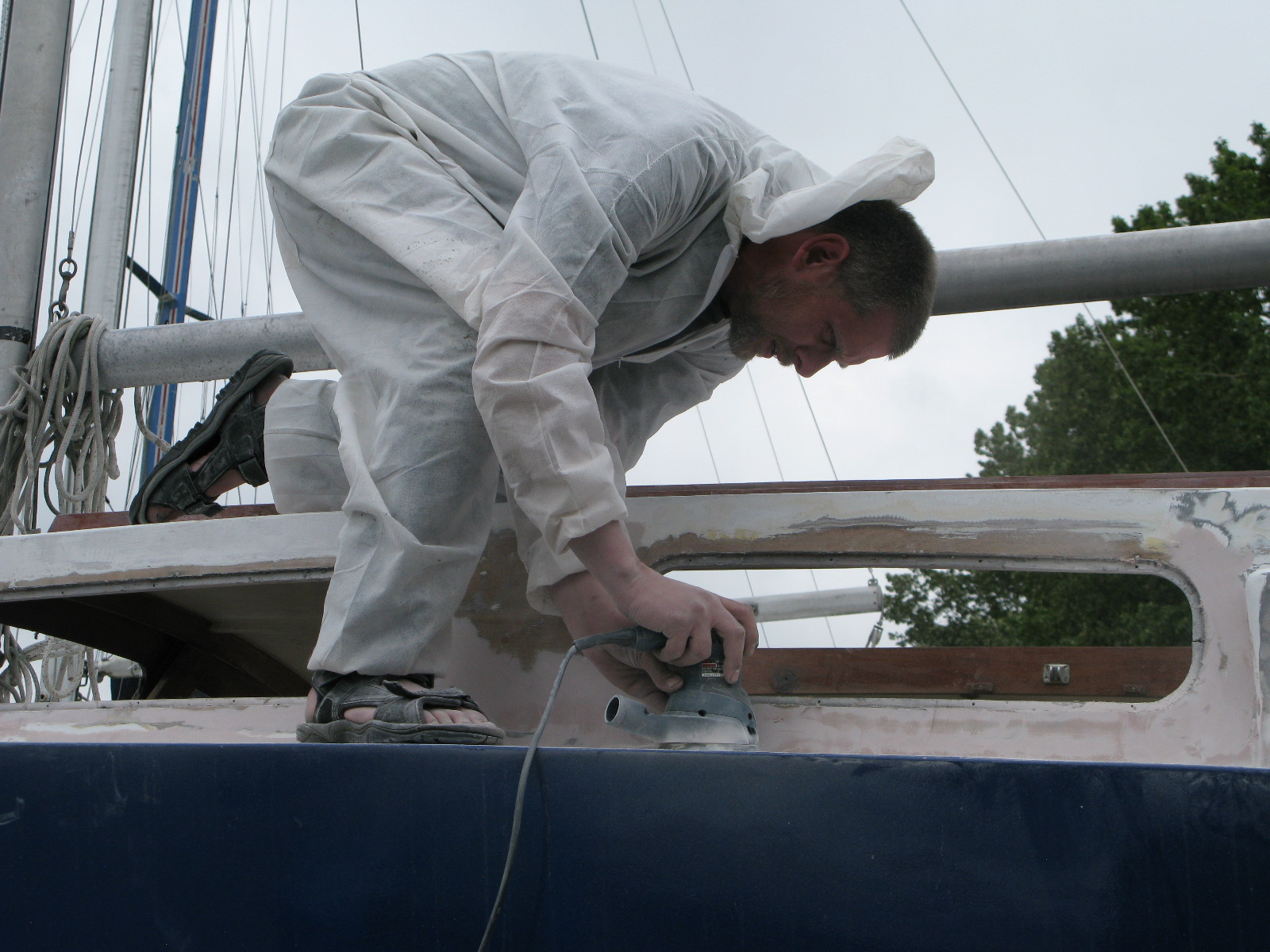
Whatever the material and construction of your boat, there will always be different problems. Wooden boats are very time consuming to fix and maintain. The positive side however is that you can easily cut out the bad patch and replace it. My boat is essentially made from marine plywood that is covered with fiberglass. I learned fairly quickly how to mix resin and apply mat glass and I must have gone through 6+ gallons of bondo putty. I had to buy several tools. The ones that paid off for themselves the quickest and most used were the grinder, the orbital sander and my trusty old Leatherman multi-tool.
Another aspect of this boat restoration that was cool was the recycling of materials. Several times I used plywood from construction sites that was destined for the trash bin. One day, while throwing stuff away in the boat yard dumpster, we came across cut up pieces from an entire deck of a large sail boat, all teak strips, on teak plywood. As I needed to re-do the three hatches on my boat, Albert had the brilliant idea of using this wood, making an outside frame using peeled off strips. In all, it took probably 4 days on those hatches, but they look amazing. To buy new teak would not only have been difficult to find but would have cost a fortune.
Once the main patches on the deck and hull were done, and all of the hardware on the deck was taken off (teak toe rails and hand rails that were brought home, sanded and varnished) it was time to paint. Albert is the expert in that department and he decided to go with spraying a two part epoxy paint. The actual painting is fairly quick, it's all the prep time that takes forever. That included coats of primer, sanding, more sanding, masking with tape and paper... The rainy weather in June was not cooperating and we had to do it at night as some people in the boatyard would probably be worried about spraying in the open. We had covered neighbouring boats with tarps so all was good. Working in a boatyard, you meet all your neighbours, working on their boats. A very interesting collection of individuals all with their stories. Everyone was really helpful and often lent us use of tools, compressor etc.
After all that work and costs, I wanted to make sure my boat would be insured. To do that however, your boat needs to be surveyed by a marine surveyor. In other words, someone comes by and checks your boat out completely to make sure it's sea worthy. Certain issues, like a sealed box with an outlet for the propane tank need to be to a certain standard. It was a bit stressful trying to finish it all and I kept pushing back the date of when I was going to go back into the water. Finally, it all happened and the motoring up the South Arm of the Fraser (against the strong current and amongst massive tankers and tug boats) to the North Arm, (now with the fast current) and back to False Creek took just over 4 hours. Albert, who lives on his boat, had anchored in the river and came back with me the same time. A gorgeous sunset when we finally got back to the ocean from the delta. It felt good to be back on the water. Went for a sail a few days later and the Manta Ray looks great. Time to enjoy the rest of summer.