
It started with a postcard that I bought in a bookstore several years ago. It was a photo of a fisherman from "Madagasikara" with his outrigger canoe, gorgeous emerald water, palm fringed shoreline in the distance... Seeing it on my fridge at home, I would occasionally wander off in my mind to that place. My only previous knowledge of "l'île rouge" as it's sometimes called in French, were stories from my high school friend Edmond, who as a kid in the 70s, had lived there several years with his family. I had also read about how the first inhabitants were austronesian peoples that had migrated there across the Indian Ocean from present day Indonesia. A google search on the country often brings up, rather unfortunately, the Disney movie of the same name on the cute lemurs that are endemic to the island. Although part of Africa, Madagascar is apart, culturally, linguistically and geographically. Good enough reason to visit, that plus my interest in everything related to canoes and wooden boats in which this island nation still has a wide variety of traditional watercraft.

Being a large country with bad roads and poor infrastructure, I had to limit myself to one or two regions for my relatively short 3 week visit. I chose the East coast which, including a beautiful island, had some remote areas more off the beaten track from more popular destinations in the north. It always takes a few days to get back into the reality and chaos of any large third world city and Antananarivo (or Tana as it is usually called) was no exception. One must barter for everything and scam artists see you coming a mile away. Spread out over many hills in the central highlands of the country, there are many old French colonial buildings in the centre and interesting brick houses with pointy roofs. The taxi ride from the airport was in a classic old beat up Citroën 2 chevaux. The entire city seems to be an open market, with stalls and sidewalks have patches of cardboard where individuals sell everything from fruits and vegetables to radios, clothes, bicycle parts, wooden sculptures... you name it.
I stuck around for two days, then took a taxi-brousse (a small bus that is crammed to the gills and stops everywhere) for the 8 hour trip to Tamatave, a port city on the east coast. Once at sea level, I was back in the heat and humidity of the tropics. Tana, because of it's elevation, has a cooler climate. I eventually made my way up the coast to a small town and local beach called Foul-Pointe then onward to île Sainte Marie, several hours and a boat ride up the coast. Nice to get out of the bigger cities. I went to the southern end of the island then took a 'pirogue' (dug-out canoe) to île aux Nattes and to a small bungalow outfit called Chez Sika, run by a Malagasy woman and her French husband. It was indeed paradise with turquoise-green water, a coral reef in the distance surrounding the island, beautiful white sand beaches... I stayed a week.
 |
| The Ritz has seen better days - Tamatave |
 |
| Ravinala - 'l'arbre du voyageur ' You can drink fresh water from this tree, which keeps it stored in it's fan-like stem. The national tree of Madagascar. |
 |
| taxi-brousse (bush-taxi) |
 |
| Foul-Pointe |

 |
| taxi-pirogue île aux Nattes |


There are quite a few "vazas" (Malagasy for whites / foreigners) on île Sainte-Marie. 95% of tourists are from France, as are the the expats that set up shop through restaurants, bars and hotels. The food in these restaurants is excellent. Lots of seafood and a great mix of French and local cuisine. It was interesting as well to meet and talk to these proprietors and especially nice for me to be speaking in French again on a daily basis. Malagasy are friendly people and most speak French. Their language is traced back to Borneo and is almost Polynesian in it's sound and vocabulary. "Manao ahoana - veloma" (hello - goodbye) "mora mora" (go easy) and my favourite "manguinguinamahafinaritra" (cool). Most people really had no idea where Canada was although they knew and loved Céline Dion and often played her French songs on the bus. If there were any French tourists, I would ask for their forgiveness!


Humpback whales migrate from Antartica for several months every year to have their young in these warm waters. Unfortunately, I had just missed the season. I did see nice wooden sculptures though and picked one up.
 |
| humpback whale bones |


My plans changed because I realized I did not have enough time to go to the remote peninsula further up the coast. This was due to the transport there which was one boat, once a week or an extremely rough road that, apparently, can only be negotiated by a rented 4 x 4 and takes 2 to 3 days to do a little over 300km! So I returned to Tana with a one day stop in the national park of Andasibe, famous for several species of lemurs. A morning hike through the park with a local guide did not disappoint. The cries of the indri, the largest lemur, was as loud as it was strange. We also saw a boa, several birds and of course an amazing variety of jungle vegetation and tress.


Sadly, much of Madagascar's forests have been cut, up to 80% I have been told, for the grazing of their zebu (oxen) and for charcoal, which the entire population uses for cooking. Most times, the only pristine forests that remain are small portions of land where there are national parks and even those are being encroached upon for hardwoods such as ebony or rosewood. This reality struck me as I took a 10 hour bus ride from Tana to the west coast city of Majunga. For the entire journey, apart from a 20km stretch through another national park, it was nothing but hills of red soil and scrub with scars of erosion everywhere. As in the photo below, you can see some small ravines that show patches of trees that would have covered everything else before. Once arrived at Majunga, located at the edge of a large delta and bay that flows into the Mozambique channel, the ocean was a reddish brown colour.


Language has always been a huge influence in ex-French colonies and, in Madagascar, they still use interchangeably both Malagasy place names as well as the French versions of them. Thus Antananarivo, (Malagasy) is also Tananarive (French). Toamasina - Tamatave.... Majunga (or Mahajanga in Malagasy) has a completely different feel from other cities. It's very bright and sunny with hot, dry heat. There is a muslim influence here similar to the east coast of Africa. The streets are wide and dusty, with mostly white buildings. With the furnace-like blast of heat, everything stops for the afternoon siesta.


 |
| 700 year old baobab on the 'corniche', a palm lined boulevard along the waterfront. |
One of the first things I noticed were the large outrigger canoes with sails used for fishing. These boats were not dugout canoes as on the East coast but rather made of wooden planks. They gracefully sailed out with the wind from bay in the morning and returned to the port at sunset with the wind in their backs coming from the sea. There were also much larger wooden schooners used for transporting cargo up and down the coast. The sight of their many sails on the horizon can bring you back to a time where all maritime ships in the world were made of wood and under sail.
Check out this cool post (written in French) by a Québecois who spends time on one of these schooners. http://alexhamel.com/sur-une-goelette-malgache/


I enjoyed just hanging out in this city which had an interesting feel about it. It was nice to stroll along the waterfront at sunset, the hot wind blowing from the sea. There were many food stalls along the sidewalk where you could have grilled skewers of meat and seafood with a cold beer. Like everywhere else I had seen, there were tuk-tuks zipping around town but here, they still used human rickshaws or "pousse-pousse" as they are called and not the "cyclo-pousse" I had seen elsewhere. More than one tourist I met seemed to disagree with their use, as if they were dehumanizing or something, and they would take a taxi or tuk-tuk instead. All the locals used them and I had no problem either. I pointed out that these were jobs, probably better than many other jobs out there and that many of them liked what they were doing. One of the pousse-pousse drivers told me that the city had introduced the cyclo ones but it did not work because there were some hills and they preferred the ones they had.


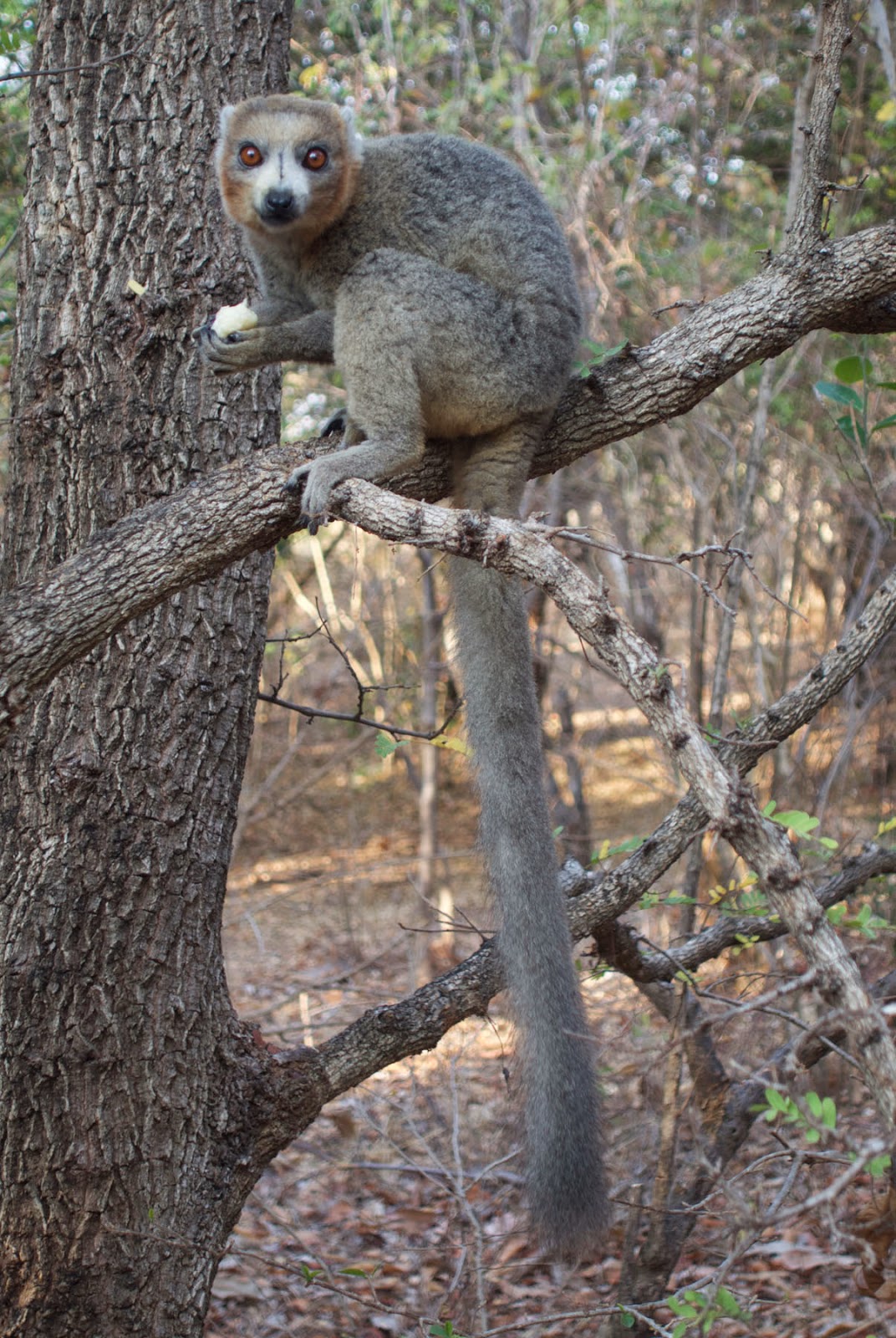
I spent a few days at a fishing village across the bay on the southern shore. There was a small bungalow outfit run by a local family where I was the only guest. I enjoyed the tranquility of my surroundings which allowed me to catch up on a few books I was reading and doing some watercolours in my sketchbook. I enjoyed just watching the local fishing boats coming back in the late afternoon. I met a local who agreed to take me for a tour to some amazing red and purple cliffs as well as the hundred year old lighthouse that was designed by Eiffel, from Paris. I saw some lemurs that were used to getting a banana from the lighthouse keeper. That night, I slept on the beach, under the bright stars, waves lapping the sand. I was awoken at 3am by half a dozen zebu that just about walked over me.


 |
| sifaka eating a mango |
The boat back to Majunga is sort of the same as the taxi-brousse. People clamour on until it is completely packed. They do handout life jackets however. Luckily, the waves were much smaller than when I had come across. Two more days hanging out in Majunga before catching a flight back to Antananarivo.
I opted to take a hotel near the airport as I was hoping to catch the Air France flight to Paris that night. My trip almost over, I bought a few souvenirs from a large craft market as well as a package of fresh vanilla that people had been trying to sell me the entire time I was there. I had read that there was a "Croc" farm in a village nearby. I was pleased I took the time to go see it as, apart from a dozen ponds of crocodiles, they had many different reptiles including several species of chameleons that I did not get a chance to see in the wild. Of course, there were some lemurs as well that came down from the trees for a banana from the guide. It was a little odd too though in the sense that they had crocodile leather products for sale as well as a restaurant that served croc burgers and croc brochettes.
The stand-by flight to Paris was totally full, so I stayed one more night before leaving the next day on the long return home on Kenya Airways to Nairobi, then on to London and home. As always, back in the familiar space of the aircraft's fuselage, looking out the window at the land and sea below, I was thinking of this far away island and of the people I had met and the places I had seen... and I wondered if I would ever return some day.


