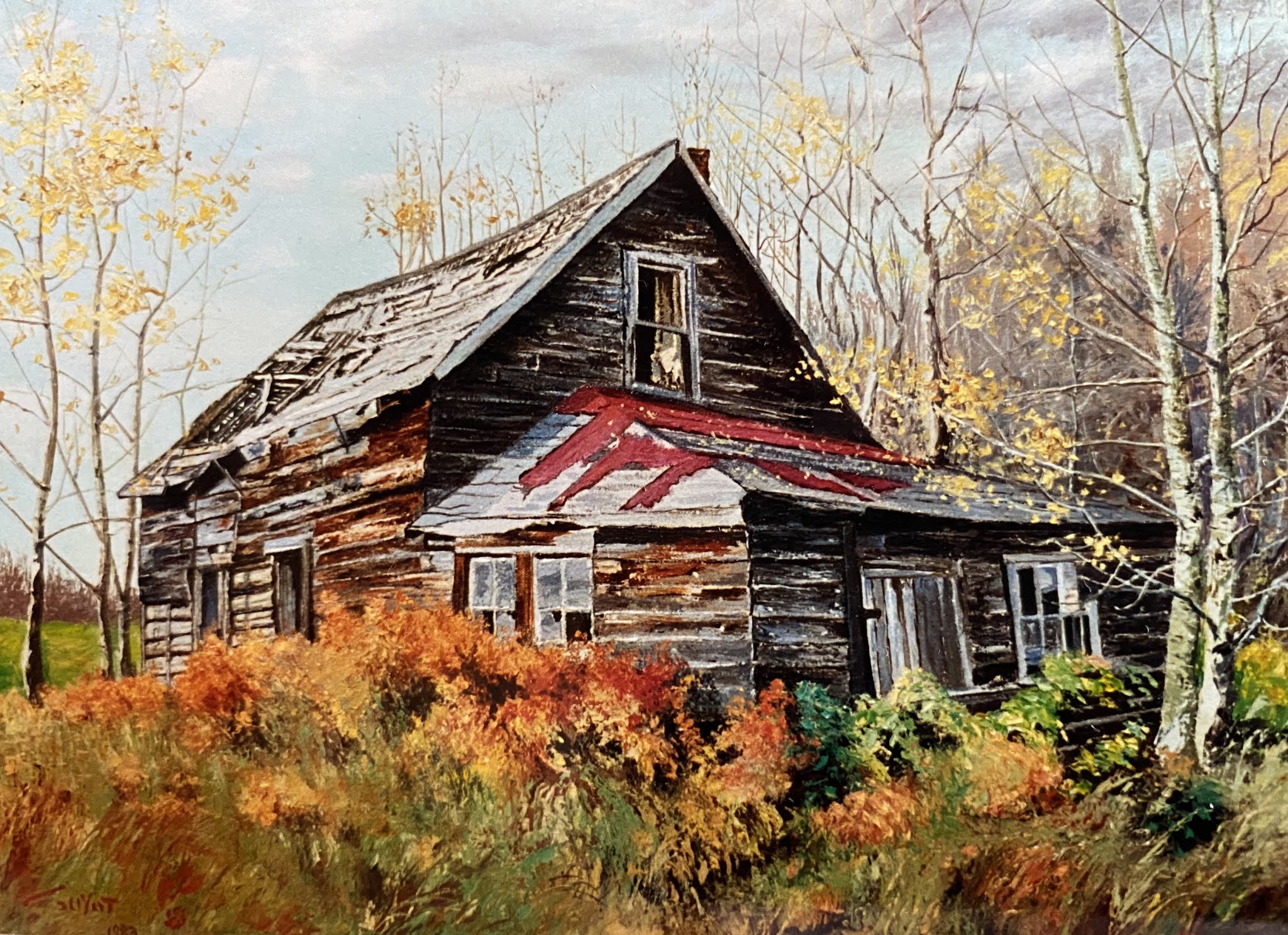
My father, Paul Sébastien Guyot, was an artist. For as long as I can remember, he would spend hours in his downstairs studio of our suburban home painting oil on canvas. He was an avid outdoorsman as well and taught us four kids how to appreciate and enjoy the beauty of nature. Our family would often go out on canoe trips and hikes in the 'Shield' country (the boreal forests, granite rock and thousands of lakes that occupy two thirds of Canada). Or perhaps it was for a day of snowshoeing on a frozen river, with the blueish shadows of snow banks and sculpted, wind blown dunes of sparkling white.
I remember as a child, on hot summer afternoons, when the prairie skies of Manitoba turned dark and storms of booming thunder and lighting bolts would hit, my dad and I would stay outside on the porch, excited and in awe at the power of nature. All of this was reflected in his art. Nature was his passion and inspiration. Along with photography, he loved capturing it in all its glory, from reflected sunsets on a lake, to colourful autumn trees, to moss covered rocks on a shoreline, to those stormy skies over a prairie wheat field.
 |
| "Jackpine" |
He sometimes did sketches out in the field, with both crayons and acrylics. However most of his work was done in his studio with oil paints. He usually used Kodachrome slides of photos he took for references and painted mostly with a palette knife. He was very good at mixing colours. When I started showing interest in art myself, I remember him showing me how he did it and being impressed at how quickly, with a few dabs of paint here and there, he got the exact colour he was looking for. He also said that you should never be afraid of 'putting it on', something you could easily see he did with the palette knife strokes in his paintings.
 |
| "The Ridge" |
 |
| "Flaming dogwoods" |
 |
| field sketch (acrylic) |
 |
| Pastel sketch of Northern Lights |
 |
| charcoal study for Bison painting. |
 |
"Heron at dawn"
|
 |
| "After the Storm" |
Although most his paintings were of the lake country of eastern Manitoba and NW Ontario, he also painted typical prairie scenes... an old grain elevator with hay stacks in a field, rusting farm implements in overgrown tall grass or twisted barbed wire fence posts in a snow covered gully. His work as a CBC cameraman brought him to many locations in Canada. He was always very fond of the North. One of my favourites is an earlier painting he did of the tundra, with it's stunted trees and colourful moss. You can almost feel the cold wind.
 |
| "The Barren Lands" |
 |
| "Rushing River" |
 |
| "Poplar Bay" |
 |
| "Wagon wheel" |

 |
"Old cabin"
|
 |
"Rosie's cabin"
|
 |
| "Farm house with dramatic sky" |
 |
| "At the mercy of the wind" |
 |
| Prairie road |
 |
| A plein air in gouache and pen. |
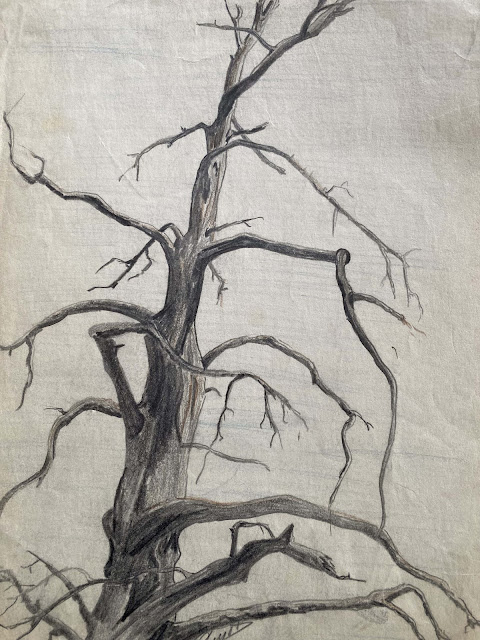 |
| I love this simple pencil sketch. |
 |
| Felt pen sketch |
 |
"Poplars on a ridge"
|
 |
| "North Cross Lake" |
 |
I liked how this one is a bit 'modern'.
|
 |
| "Portage" |
 |
This one is quite small, 10x12" I love the palette knife strokes
that make you feel that strong wind. |
My father must have painted an average of about ten paintings a year for over forty years. Although he did not earn a living with his art, nor was he represented in a commercial gallery, he was well known in our community of Saint Boniface and Winnipeg and he had many exhibits over the years. He must have sold at least half of all the work he produced. This painting of a great horned owl on the lid of a wooden barrel was a very popular one that he could have sold many times over but I had put my name on it. He had once told us that each one of us four kids could choose 3 - 4 paintings we like to keep for the future.
I was quite young at the time, so some of my choices changed over the years but I always kept this one.
 |
| "Great Horned Owl" |