I had heard of this famous canoe route several years ago and thought that it would be a perfect place as an introduction to paddling and camping for Irene and her two boys. Most people do the entire circuit, a series of lakes in BC's Cariboo mountains that are linked by rivers and portages and which usually takes 6 to 9 days. A shorter trip up and down the west side takes about 4 days. We opted for the latter.
I was a little surprised at some of the requirements in planning the trip, i.e. having to book in advance your time there, some of the costs, an obligatory orientation... however, I realized that it is an extremely popular canoe route and the Parks Board must limit the amount of people using it, especially in the busy months of July and August. As my canoeing experience was always in more remote areas of Manitoba and Ontario, the existence of wide, groomed portages where people use wheeled carts to carry their canoe and gear was an interesting one for me. As well, paddlers can only stay at designated campsites and must use the tent pads, fire pits and bear caches for food that are in place at each site. Some spots even have cut firewood provided for you! All understandable though, considering the number of people using the park. Keeping the impact on the nature of these sites to a minimum is an obvious priority.

We left Vancouver at 6:00 a.m. and made it up the scenic Cariboo highway in central British Columbia to Bowron Provincial Park by late afternoon. After having spent the night at the campground there, we picked up a rental canoe (had to get a fairly long one to fit the two boys and the gear) and we were on our way. As we were doing the west side which only had two short portages and one somewhat long one, I chose not to rent the wheel cart as it would take up a bit too much room in the canoe. (I would feel the weight of that 85 lb canoe on my shoulders later though!) The water was like glass and the sun was shining. Nice way to start the trip.


When we got to the next lake, the boys tried their hand at paddling (somewhat successfully) to give Mommy a break. I put out a fishing line and caught a small trout. I threw it back thinking it was too small, forgetting that in mountain lakes, often that's all you get. Speaking to some other paddlers who had just done most of the circuit, it seemed that the fishing was not that great. We were lucky in that our first campsite, which had a log shelter, a cabin and room for a dozen tents, was empty except for us. The mosquitoes however greeted us in full force and the netting that Irene brought for herself and the boys helped. I brought along some Deet which I did use on the portage the following day.

At the end of Bowron lake there is a huge marsh area, where the Bowron river flows into the lake. There are several meandering river-like passageways through the marsh and we went the wrong way a couple of times. I must admit though, the map provided at the orientation was not the greatest. Excuses, excuses... We saw another canoe party heading through the right passage way which had an orange marker, so after lunch, we followed the right way. As mentioned by the ranger, the high probability of seeing moose in this area did not disappoint and we saw a young female eating weeds in the water nonchalantly as we paddled by.

The following day was also a calm one on the water. We met quite a few groups of canoes going the other direction. At the long portage, carrying the heavy canoe was indeed quite exhausting and I envied the wheel carts we saw the other parties using. The boys did pretty good carrying the gear, but we still had to do two trips to bring all the stuff over to the other side. Once we got to our campsite at Unna lake, a small lake with a great mountain view, we set up the tent, stashed the food in the metal bear cache box, then paddled to the other end of the lake to a hiking trail that brought us to a magnificent waterfall of the fast flowing Cariboo river.

Another beautiful sunset, a good meal and a garder snake at the campsite before leaving the following morning toward the return trip. I would have liked to explore a bit further but the paddle to the next lake required going several kilometres up the Cariboo river which, at this time of year, had a much too strong current against us. After finishing the three portages, the clouds moved in, a tail wind picked up (thankfully) and the rain started falling. It's actually great to have a variety of conditions and I didn't mind being out on the lake with drops hitting the water. It's almost preferable to a windless day with the hot beating sun on your skin. We stopped for lunch, continued on through a narrow passageway just before our last campsite and I set out the line for the boys to fish and they caught three 'pike minnows' within half an hour. A first for the boys who were very excited. This time we kept them and once arrived at the camp spot, the rain conveniently stopped falling for us to set up the tent and get dinner going. These fish had lots of bones and they weren't that tasty but it was still fun.


We set out quite early the last morning and we were back in the large marsh area. This time we saw two bull moose as well as a female. Beautiful! Although it was only 9:00 a.m. by the time we got out of the marsh and into Bowron lake, the wind was blowing strong against us and there were whitecaps on the water. We had to paddle diagonally against the waves to get as close as possible to the shore. It was a bit nerve wracking for Irene who had never experienced those kind of conditions but it subsided as soon as we got close to shore and eventually the wind died down further along the lake.


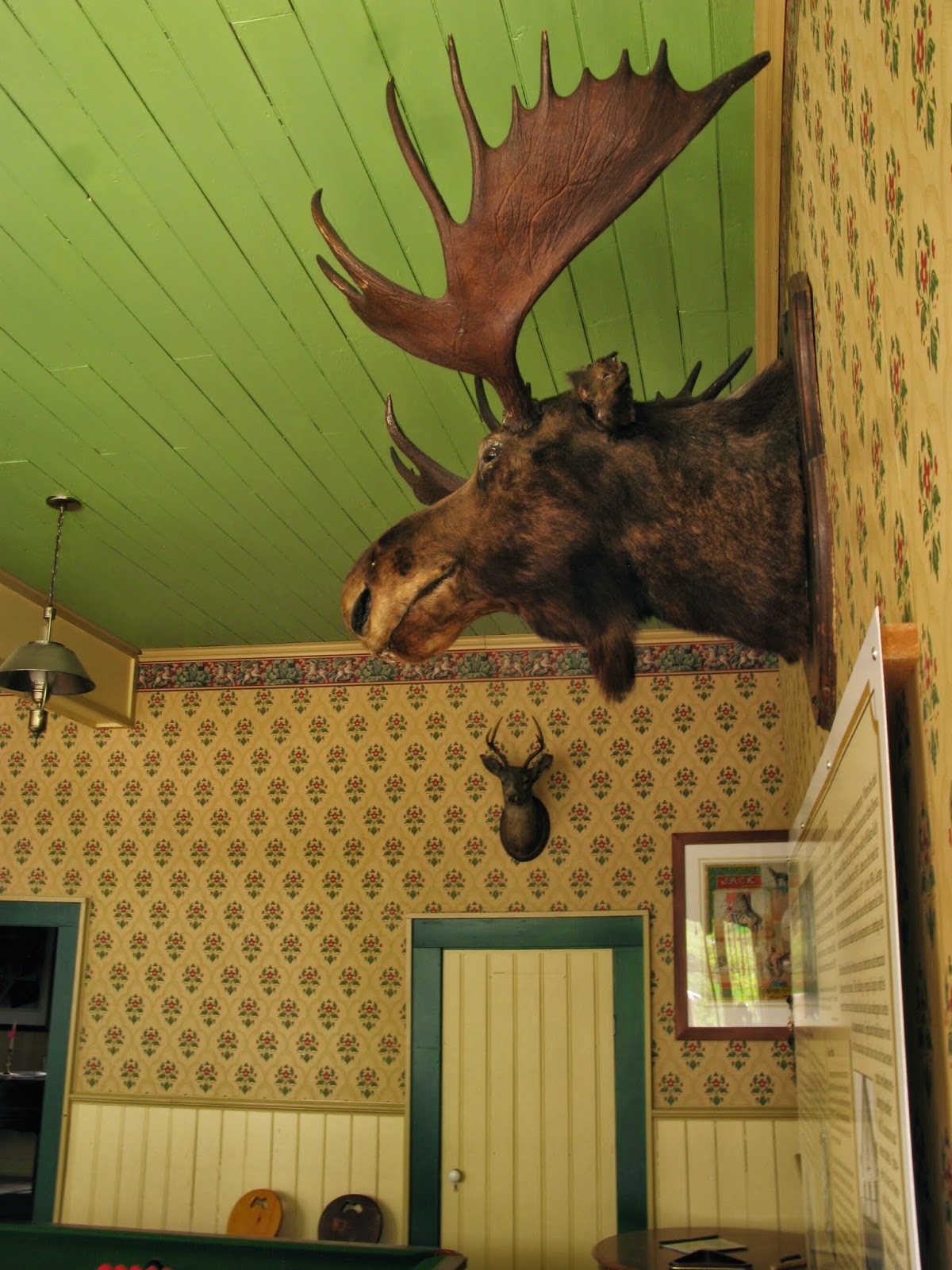
We landed at the outfitting place around noon, loaded up the car, then drove to nearby Barkerville, the famous gold rush town in BC that is preserved like it was over 100 years ago. There was an interesting assortment of log buildings and even better, people dressed in period costumes, strolling around, assuming characters of that time. Lots of historical information of life during the gold rush, anecdotes of people who came from all over the world to this isolated region of northern BC. As always after a camping trip, it was nice to sit in a restaurant and have a good meal. The one in Barkerville was amazing, in an old style restaurant with a wood stove in the middle of the room, the wall paper of the era, the waitress in a long dress. The lasagna and quesadillas were so good. The road trip back home split into two days as we took a motel in the picturesque little town of Clinton, halfway back to Vancouver. Overall, an awesome trip. I will definitely return one day to do the entire circuit.