Friday, July 10, 2015

Kayaking Kyuquot

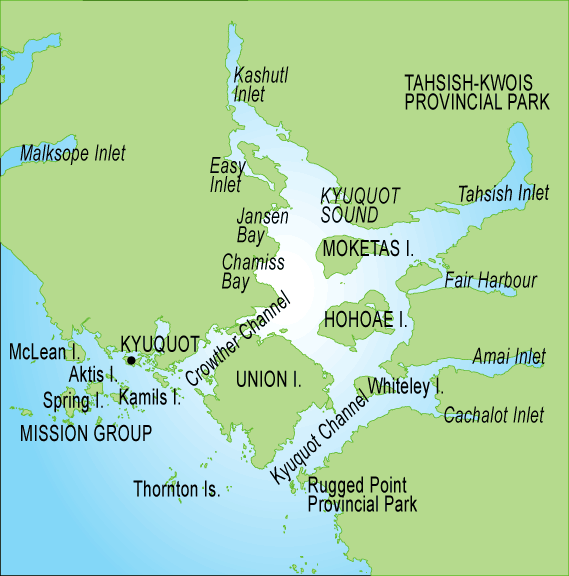
A last minute decision to do a solo kayak trip in June, brought me back to Kyuquot Sound,  a spectacular region of NW Vancouver island that I had been to before, already 10 years ago.  After getting all the preparations ready, I threw my trusty old baidarka on the roof of the car and made the somewhat long trek,  ferry to Nanaimo,  drive up the island highway and  logging road to Zeballos.  I spent the night at Nick's,  a colourful Bulgarian with whom I had the pleasure of meeting 8 years ago,  on another kayak trip with my friend Erik to Esperanza inlet.  Our thoughts at the time of Zeballos becoming perhaps the new Tofino did not materialize at all.  It's still a tiny, sleepy,  two-bit town in the middle of nowhere, at the end of the gravel road.  I left early the next morning to drive another 45km north-west on another logging road to Fair Harbour, where I parked and put in at the end of a long inlet.  I was on the water and paddling by 10:30.  Luckily,  it was overcast and cool, with just a light breeze.  I paddled a couple of hours to a small pebble beach on one of several islands of the inlet. That's about the longest I can handle sitting on my butt before my legs start getting numb. The places to land however are few and far between with either the forest dropping right to the water or a series of seaweed covered rocks at low tide. 


Back in the yak, it was another hour or so of paddling before I could the see the horizon of the ocean and feel the swell on the water.  I always get excited at that point because the marine environment changes.  You start seeing different rock formations, a lot more kelp and marine wildlife like seals and sea otters.  There is more variety than the long inlets of green forest that come down the mountains to the water. 


Another stop on a beach to stretch my legs before paddling the last leg to my destination, the western end of Spring Island. Part of the Mission group of islands,  it juts out into the mighty Pacific in a relatively sheltered way  from the coast.  I remembered this spot from my previous trip and knew that it is one of the best places to camp on the entire west coast of Vancouver Island.  The western tip of the island is a bit like an hour glass,  with two beaches, one facing east, the other west.  Enough room in the middle to put a tent near a small grove of trees.  You can watch the sunrise on one beach facing the south eastern coast of the island as well as watch the sunset on the other side, facing the mountains of the Brooks peninsula.

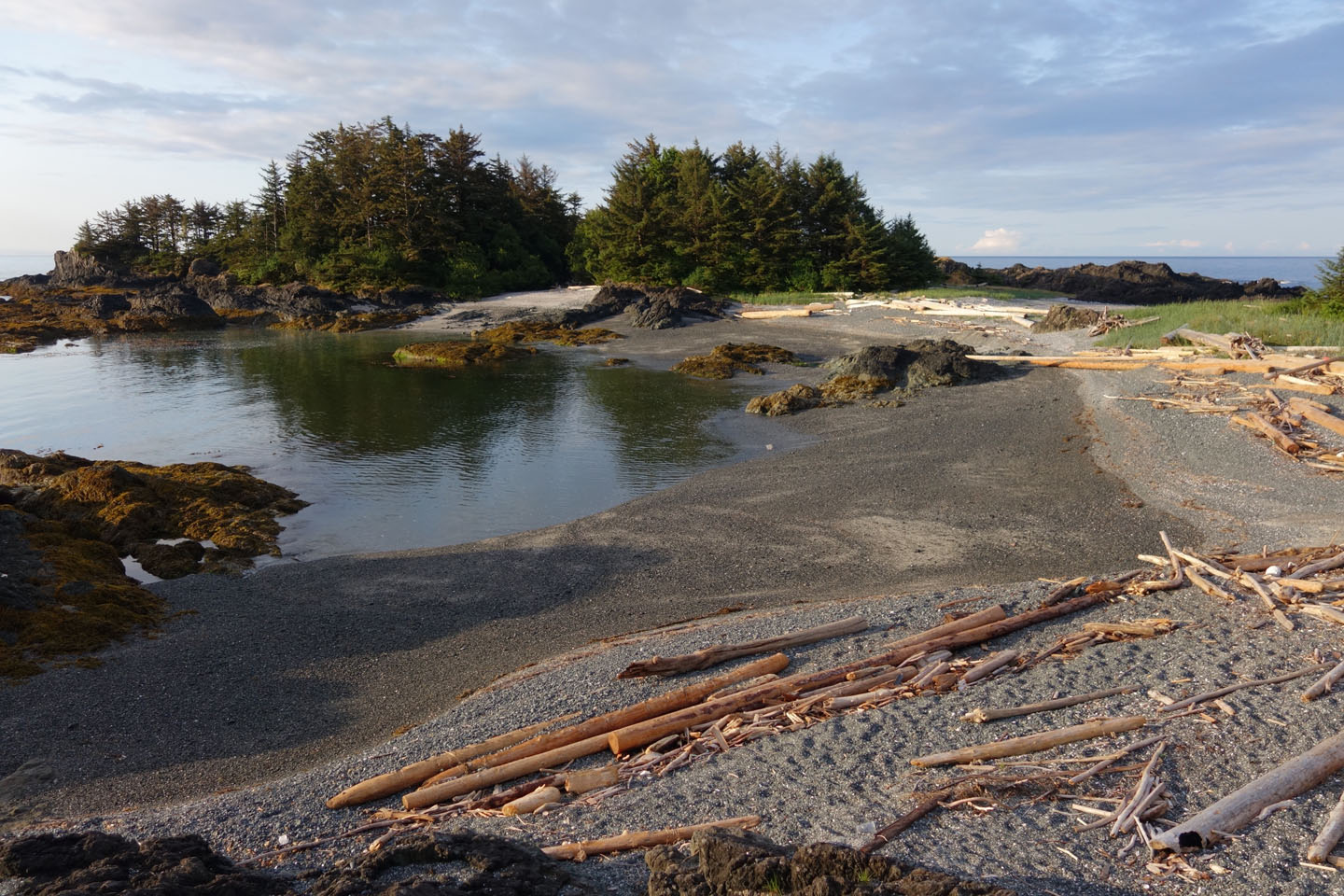


I ended up staying there for five days.  There was lots to explore on foot as well as in a kayak.  Many natural pools of water filled at high tide, jagged black volcanic rocks and reefs, windswept trees... and always the sound of waves.  It takes a while to get used to being alone, to slow down and absorb the rhythm of your natural surroundings.  I find that to be a good experience.  You really are alone,  small and insignificant in the world. Nature is indifferent to your existence. You tend to do things to keep busy but of course you have lots of time too for reflection or just to appreciate all the beauty around you.

I remembered a turned over driftwood stump with its root system exposed on the beach.  It was there ten years ago, but in a different spot.  The winter storms most likely tossed it further up the beach.  There are hundreds of driftwood logs, some that fell naturally, most from logging.  I had noticed many freshly cut logs scattered all over the rocks and beaches.  One spot had enough to build a house and I estimated that one of those logs, especially the cedar ones,  would be worth several thousand dollars each.  A few days later, whilst  on a paddle, I met a local man in a skiff who was surveying the logs.  Turns out his brother had cut several hundred logs that were all on a barge out  off the coast.  A crucial stanchion broke, tipping the entire load into the ocean as well as the crane. This happened a month ago.  Some were being recovered, many however were in spots that would be difficult to haul out with a boat and wenches.


A few watercolours I painted on Spring island.


It was my first time back on the west coast camping since the tsunami in Japan.  I was expecting to see perhaps more garbage than usual on the beaches.  Sure enough,  there were many brightly coloured fish net buoys, with Japanese writing on them.  There were also a lot of Chinese plastic drink bottles and lots of junk from the English speaking world as well.

After five days, I paddled the one hour to the town of Kyuquot, a small village and native settlement on the coast, accessible only by water.  It was Sunday morning so everything was closed.  Just before getting out of my kayak on the dock,  there was a large sailboat with a Kiwi flag at the stern.  From their deck looking down at me, I met Pete and Raewyn who live on their boat and have been sailing the world in it. They had just come down from Alaska and were spending another week on the west side of Vancouver Island before crossing over to Hawaii then to the South Pacific and back to New Zealand.  They were "living the dream" as sailors often say.  They told me about a house over on settlement side that was like a store, and that if I knocked, they would most likely open up.  I paddled over,  filled up on water and bought an ice cream as well as a couple of jars of canned salmon that the Kiwis told me was very tasty.


Back at camp,  I decided that the next day, I would paddle over to Rugged Point, at the southern end of the Sound and spend a night or two there before returning to Fair Harbour.  I watched another spectacular sunset, had a few shots of scotch from the flask whilst enjoying a small fire and noticed Venus shining bright in the sky.  I never ended up going to sleep when it was completely dark as it was the week of summer solstice and there was still a wee bit of light up until 10:30 pm.  I woke up early the next morning as I was hoping to break camp and be on the water by 6 am.  It's usually quite calm until noon but that night the wind picked up and I heard it whistling through the trees. I crawled out of the tent to a grey sky and a good size chop from the SE, the direction I was paddling into.  I decided to go back to bed.  Walking up a few hours later,  the waves seemed to have subsided a little.  I listened to the forecast on the VHF radio and there was nothing more than 15 knots for the rest of the day.  I had a quick bite and started to pack my things.  As I was folding up my tent, I saw a lone wolf walk by on the beach, about 30 feet away.  He ignored me as I watched him trot along the shore.  I got up and watched him for a few minutes until he disappeared into the forest.  All of a sudden, I  had a surge of emotion as I thought of my father.  He loved wolves and I felt like as if it was his spirit, coming along the beach, to check up on me.


I paddled across a section with many reefs, which helped break the waves coming at me almost broadside.  When I went by a section called the White Cliffs on Union island, I thought of the time I was here last, we were going the opposite direction and ended up in these massive swells of about 8 feet.  We had to  paddle at least a km from those cliffs because of the rebound effect of those massive swells.  It was probably the scariest time ever for me in a kayak.  It was a good two hour nerve wracking paddle before those same reefs I had just passed offered protection.   I went on the inlet side of Rugged Point and set up camp just before seeing the Kiwi sailboat on the horizon.  Pete and Raewyn  dropped anchor and came ashore in their dinghy.  We went along the short hiking trail to the long beach facing the ocean side. Both times I had been to Rugged Point, there were cougars that had had encounters with humans.  The last one happened last fall, a local in the village told me that a kayaker was on the beach, taking a dump near the driftwood logs when a cougar jumped him.  His mates came to his rescue and he was ok, with several cuts.  Rangers later tried, unsuccessfully,  to find the cougar.   There were bear, wolf and cougar tracks on the beach, and I told the Kiwis that the last time I was here, I had seen a pack of wolves at that very spot.  I could not think of a better name for that small peninsula than Rugged Point.


It was a gorgeous day the next morning but I decided to pack it in and paddle back to Fair Harbour. It was a little too calm on the water when I set out and I was getting hot.  Thankfully, after an hour of paddling, the wind picked up in my back and was blowing toward the inlet where I was headed. By the time I almost reached the car, there were small white caps.  I met a couple of kayakers that were just heading out, we chatted a bit, bobbing in the waves, but I did not envy their paddle to the ocean against the growing wind and waves.


I spent the next five days visiting my good friends Erik and Naomi and their young son Julian on Cortes Island.   Some great meals were had with his parents and their friends.  We tried fishing, unsuccessfully,  for salmon with a down-rigger (a first for both of us), whilst trolling in his skiff.   On one day, we were both a bit bummed and somewhat bored because we did not get a single bite. Never mind the fact that we saw some orcas, a black bear walking on the beach and an eagle swoop down to pick up a small stunned rock fish we had thrown back.  As Erik said, a German tourist would be having a 'wilderness wet dream' at what we had seen that day.


Cortes is a beautiful island with an interesting variety of locals,  people from all over.  Almost everyone has a boat, or two.  That got me thinking small sailboat again...  One of their friends uncovered an umiak, (a large skin-on-frame open boat that the Inuit used to hunt whales) that was covered in the forest for many years. After hauling it on a trailer to one of the lakes on the island, we went for a sail with it's two mast sprit-rigged sails.  Now that was a lot of fun!  I also appreciated the many arbutus trees on the island, apparently their most northerly range in the Gulf islands.  The weather was gorgeous and time flew by before I had to return to the city and work.  I was hoping to see a humpback breaching from the ferry to Quadra island like I had on the opposite way five days earlier.  Such an amazing group of islands on one of the most spectacular coastlines in the world.


Friday, December 26, 2014

Istanbul


Istanbul, known in previous centuries as Constantinople, is one of the oldest and most interesting cities in the world.  Irene and I had a week off at the beginning of December and decided to visit this historical and vibrant city.  We were lucky to get business class both ways on the flight from Toronto (what a difference a flat bed seat makes!)  It was our first time as well getting accommodation through Airbnb, a great experience.  I don't think I'll book a regular hotel ever again.  Over the course of 8 nights, we rented two places, both in the central district of Belogyu,  both old European style apartments with a lot of character and excellent rooms and at a fraction of what a hotel would cost. 


Being the month of December, it was cloudy most of the time and a bit chilly with the humidity of the Bosphorous,  that strait that divides the European half of the city from the Asian side.   However, the bonus was that there were much less tourists than most of the year where line ups at all the historic monuments are, apparently, legendary.  We spent the first day just strolling around the main pedestrian street of Istiklal up to the famous Taksim Square.  It did not take us long to sit down at a cafe for a Turkish coffee with a snack of baklava.  There are dozens of cafes and baklava shops in that neighbourhood.  It would be a pattern repeated several times a day during the week, but alternating with tea, which is even more popular with Turks than their coffee. 


Our second morning, it was time to visit the historic peninsula of Sultanahmet by walking over the famous Galata bridge which crosses over the Golden Horn, yet another famous body of water in the city, an inlet that curves northwest a few kilometres.  First though, we went up the Galata tower, a medieval stone tower built in the 14th Century which gives you a great view of the old city.  Crossing the bridge, I was reminded of a documentary I had seen years before, which had shown the passion of Istanbullus for fishing.  There they were on the bridge, with their long rods over the edge of the railing, fishing for sardines. 

Galata bridge and the New Mosque

 The 'New Mosque', (built in the 17th century) is a prominent architectural landmark as it's right near the water of the Golden Horn and across the bridge.  It was the first of several mosques we visited and the interior space under the dome was indeed impressive.  I love the geometric patterns of the tiles and the calligraphy, verses of the Koran, throughout the marble columns and domed ceilings.

We wandered through the Spice Bazaar sampling a variety of Turkish delight, then on to the world's oldest shopping mall, the Grand Bazaar.  It's huge and quite impressive with its vaulted ceilings and shiny lights however, somewhat touristy and locals, I was told, don't really go there to shop. I did buy a few pepper grinders as gifts for friends.  We ate at a popular style of restaurant called lokanta, a sort of cafeteria-buffet where you can point to several intriguing dishes. The lentil soup and the rice pudding were very nice.   We then continued on to one of the larger mosques in Istanbul,  the Süleymaniye Mosque built by Sultan Süleyman, (the Magnificent) in the 1500s.  We were getting to learn a little more on the Ottoman Empire with each visit and it gave my the desire to read more on this period of history once I got back home.


The next day was devoted to the Blue Mosque and the Hagia Sophia,  the most famous landmarks in the city.  Irene looked like an Asian Muslim whenever she put on the obligatory shawl over her head to enter a mosque.  Again, more impressive domes, tiles and calligraphy.  The Hagia Sophia is quite simply one of the most fascinating architectural structures on the planet.  Built as a Greek Orthodox cathedral during the Byzantine era of Constantinople, which lasted from 537 until 1453, then converted to an imperial mosque by the Ottoman Turks from then until 1931, when it was converted into a museum. For a thousand years, it was the largest interior space in the world.  The domes had Christian Orthodox mosaics of Jesus and other Christian figures which were then covered in plaster once converted into a mosque by the sultans.  The plaster was removed once it became a museum revealing the Christian mosaics once again, alongside the geometric patterns and Islamic features such as the minbar (pulpit) and mihrab.


Sultan Ahmed Mosque,  popularly known as the Blue Mosque


Hagia Sophia (Ayasofya)


We took a break from the mosques and monuments the following day and took a boat up the Bosphorous strait, hoping to get to the last small town on the Asian side, before the Black Sea.  However,  an hour into the ride, the fog rolled in and the boat could go no further.  Along with a dozen other tourists, we had to take the bus back.  We did see most of strait however, including some old forts and  Sultan palaces from centuries past.  Always nice being on the water, even with the palette of grey skies, low clouds, rain and fog.  

Spending a day on the Asian side of Istanbul, a short ferry ride across the Strait, was a nice change from the older and denser European side of the city.  Just wondering the streets, a coffee here, a bite to eat there, strolling through markets and some residential districts...  made for a pleasant day.


Simit - a sort of turkish version of a bagel covered with sesame seeds


t'was the season of pomegranates! 


Being cat lovers, we were both amazed at the amount of street cats in Istanbul.  They are everywhere! People feed them,  shop owners let them stroll into their stores, passers-by stop to pet them. Unlike other mega-cities, they are all in relatively good shape too.   Some did get beat up though as we heard tom-cats fighting with their wailing screeches in the wee hours of the night.


Another must-see in Istanbul is the Topkapi Palace Museum,  the primary residence of the Ottaman sultans for over 400 years. The complex, which includes mosques, courtyards, kitchens, a mint and a harem with hundreds of rooms and chambers all are fine examples of Ottoman architecture. There are some superb displays of the Sultan's jewels, calligraphy and holy relics of the Muslim world.


The sultan's crest


The Ottoman Empire collapsed in the aftermath of World War I and we were reminded constantly of the father and founder of modern Turkey,  Mustafa Kemal Atatürk.  His portraits and bust are everywhere, on each note of their currency,  framed on restaurant walls, woven in carpets, in public squares and in schoolyards.


After a wet and chilly day,  it was time for that classic experience one can get in most muslim countries,  the Turkish bath or hamam.  There are many in Istanbul, some dating back over a thousand years.  We chose one in our neighbourhood that was less expensive and was said to be the first co-ed hamam in the city.  It was also one of the older ones,  originally built in 10th century.  The "classic package" which consists of the bath, a scrub and a massage costs about  $30.  The main room had a dome and a marbled floor with a raised heated slab of marble in the centre.  We were given a cloth sarong and,  after wetting yourself at one of the many hot and cold taps along the walls,  you lay down on the hot slab to tenderize your muscles and body.  This hamam seemed to be geared to tourists and there were a few European couples steaming on the marble.  Eventually an older woman comes in the main room and says "woman come" leading Irene away to another room for her rub down and massage.  A well built young man came in and I was able to get a preview of what was in store as he worked another male tourists' relaxed body.  Essentially, they wash and cover you in suds, then scrub off all your dead skin with a sort of mitt.  Then comes the 10 minute massage.   He was pretty good and having seen the technique moments before, I was ready for the strong open handed whack on my back at the end.   Relaxing in that hot steamy room, it felt great to pour buckets of cold water on your head.  There was no time limit either.  After about an hour, we were wrapped up in dry towels in the entrance room and relaxed on cushions with a cup of tea, before heading out back into the rainy evening which, of course, does not feel quite as cold as before you entered.


Being in Istanbul an entire week,  we had the time to relax in the flat we rented,  having breakfast at home, making some turkish coffee... We enjoyed going for long walks, checking out some local shops, thinking of a few gifts to get family and friends such as the ubiquitous evil eye key chain or Turkish delight.  Of course, we had to indulge in the local pass time of smoking apple flavoured tobacco in a nargile pipe whilst playing backgammon.  There were a lot of street musicians and we got a good sample of different local music.  It was on our last night however, that I really enjoyed watching a performer in a bar sing traditional folk songs while playing the baglama,  a stringed middle eastern musical instrument which had a melancholic sound.  Our time was at an end and I thought that I would most likely return one day,  to explore other fascinating regions of Turkey that I have heard so much about.