Saturday, September 10, 2011

Salmon fishing in kayaks

It took a while for the summer to finally arrive and when it did I asked my friend Chris, from Sweden whom I had met in Yukon in the spring, if he wanted to do a kayak trip.  As an avid fisherman he was eager to catch some salmon.  I took him out several times in my skin-on-frame kayaks so he would get used to them.   He had no problem and mastered the roll after just 15 minutes of practice
.


After picking up my friend Erik's touring kayak and some food we were off to Horseshoe Bay to catch the ferry to Nanaimo and arrived  just after sunset.  It's a five hour drive north to Telegraph Cove, so we stopped halfway, near Campbell River and just pulled over a roadside parking lot along the sea and slept in the Kaiser (my old Benz).   The beautiful sunrise announced a gorgeous day ahead.

We arrived at our destination a few hours later and we were in the water by noon.  Johnstone Straight was calm and a deep blue.  The salmon were jumping all around us.   We had bought a few extra buzz bombs, the favoured lure in this part of the world, and started casting toward wherever they jumped.  After a quick lunch of salami and cheese on bread, I caught a nice sized pink salmon.  He was a perfect size for a meal for two, so I kept him.  I then caught another one which I released.  Chris caught a few as well but they were really small and I could see he was a little envious of the fighting fish I had caught.


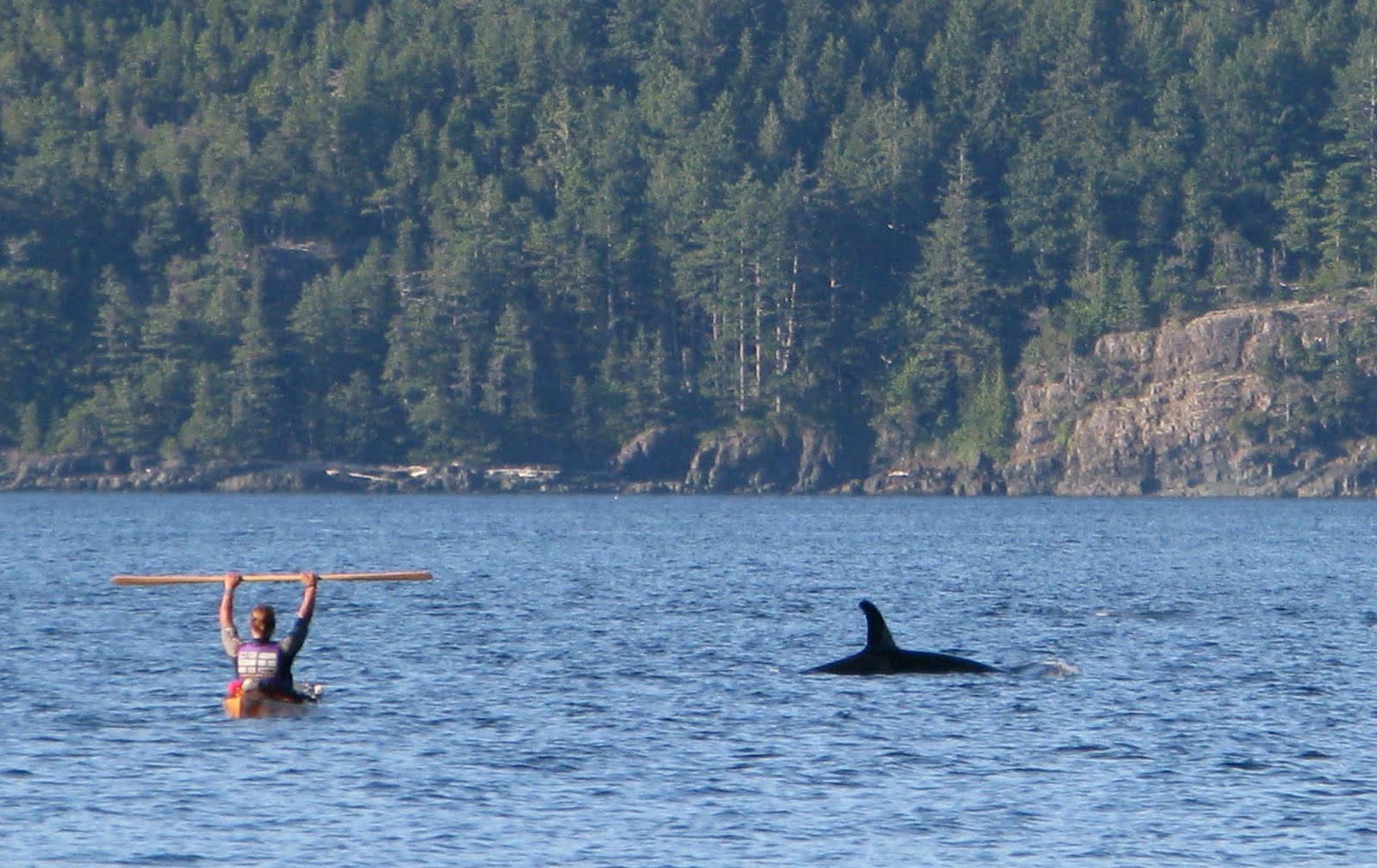
We stopped at a rocky beach to spend the night.  I told Chris to go back out fishing while I would set up the tent and get dinner ready.  The sunlight was golden and, as he was floating and casting fifty meters away from the beach, I heard the familiar "ppffffff" sound of a blow hole.  The orcas were fishing as well.  Several of them cruised by very close to shore between the two of us.  They were surfacing close to his kayak and I was glad he was able to have that awesome experience, one I have had several times before.   A few sea lions were also fishing a few meters from the beach, tossing salmon in the air with their powerful tails.  A lesser blow hole sound was that of porpoises,  joining in on the feeding frenzy and they were followed by several commercial fishing trawlers.


It was blue skies again the following morning. The water was calm so we crossed the Straight to Hansen island where we jigged our lures in deep water along some cliffs and quickly caught many rock fish, that we all released except for one that I figured would go well with the Indian curry we were having for dinner.  We had to wait a couple hours before going through a narrow channel since there were tidal rapids and a current going up to five knots.  Lunch on the rocks, bald eagles above and another blow hole blowing, this time a humpback whale who, at first was far in the distance but then appeared later some fifty meters from where we were paddling. Like a reef it surfaced and, thankfully, did not get too close.   Once again a pod of orcas cruised by as well.  The water was so clear, cold and full of life. 


Our next campsite was in a bay, with a long shallow entrance to a creek coming from the forest.  It's always a little challenging figuring out a good spot to land the kayaks as the water line of tides must be taken into consideration.  You may arrive at one spot that seems easy enough to get out along rocks or a pebbled beach, but what does it look like at low tide?  More than once I have been surprised by huge rocks full of seaweed that make it difficult, if not impossible, to re-load and launch your kayaks.  Having a tide table is essential.

We pitched the tent in the forest and cooked dinner on the rocks.  Another beautiful evening.  The coastal mountains were lit by the setting sun. A few old wooden trawlers motored by then a couple of floating hotels, the massive 10 storey cruise ships heading up the Inside Passage to Alaska.   We woke up to a foggy bay and set out on the water with a completely different feel; one of being suspended in nothingness, the horizon of water blurred with that of the sky. 


We started fishing once again, me catching the first salmon, Chris the next one but then his line broke. It was 3 - nil for me at that point.  Finally, he caught one, a Coho that was a good size and it gave a great fight, jumping out of the water several times.  He was very happy.  We decided that we would leave that evening so that meant we could keep up to four fish each, as we could put them on ice for the long ride back.  Once again, we had to wait for a strong tidal current that was going the same direction we were but was too strong take a chance riding through.   We kept on fishing but then we were slowly being sucked into the current even as we paddled further away.  This proved a little complicated when Chris caught another salmon.  It takes a good 10 minutes to land them to the kayak, before clobbering them on the head. On top of that,  we pissed off two sea lions that were also fishing and they were aggressively following us, popping their massive heads out of the water with what seemed like an angry snort only a few feet from our kayaks.   I got totally freaked when I saw one swim under water quickly next to my boat.  Think of a fast swimming bull under water that could easily knock you upside down.


The current subsided and we paddled through the channel.  The fog and clouds lifted as we crossed Johnstone Straight toward Vancouver island. The wind picked up and it was fun to paddle through waves with the sparkling diamonds of reflected sun light. A humpback was feeding ahead of us once again.  A few trawlers motored by with their bounty of salmon and us with our three good sized fish, before we arrived back at the small town that is Telegraph Cove. Another stellar trip of wildlife and natural beauty from the sea of Vancouver island.

Tuesday, June 21, 2011

Yukon paddling

It has been several years now that I have thought about and planned to canoe the Yukon river. However, it always fell through for various reasons until finally, this was the year to make it happen as I had two weeks vacation during the first half of June.  My friend Shinyi was able to take a couple of weeks off work on short notice, so it was a go.   It did not matter that she had only ever camped in car park campsites or had never been in a canoe, (she has paddled in Dragon boats though) she was eager for a wilderness experience up North.


A few years ago, as I was planning this same trip,  I struck up a conversation with Sue, a passenger on a Toronto - Vancouver flight.  Turns out she lived in the Yukon and had invited me to contact her and her husband Larry anytime when I would be in Whitehorse.  Well I looked in my little note book and found her e-mail address.  I fired off a "do you remember...?" email and she responded with an invitation to stay at their home!  True Northern hospitality.

After writing lists of stuff to bring and getting all the gear ready, we took the flight to Whitehorse where Larry picked us up.  We spent two nights with them with great food and conversation.  They lent us their truck to get our groceries and we picked up a rental canoe from one of the outfitter companies in town.  We were originally planning to put in the Yukon river which flows through Whitehorse, however there was an alternate river, the Teslin, which runs parallel 100 km to the east and joins the Yukon downstream a few days from Carmacks,  about 400km away and our final destination.  Larry was willing to drive us the 100 km to Johnson's Crossing,  a bridge on the Alaska highway that crosses the Teslin and the put in point for paddling that river.


The weather was cool, mixed cloud and sun, with the occasional downpour.  Shinyi got the hang of paddling pretty quickly.  The first few days on the Teslin, the current was not very fast but it picked up considerably as the days went by.    On our first night, we met another camper, a young man named Kris, from Sweden.  He was on a solo canoe trip for 50+ days and going all the way to Dawson city. An avid fisherman,  he would spend several days at one camp and fish most of the day (catch and release).  He had found a great spot across the river from the campsite, in a  shallow, swampy bay where the pike were biting big time.  He took me there the next morning and sure enough, on the first cast, bang! a 10 pounder.   I caught five of them, thanks in large part to his hand made floating lure that drove the fish crazy as it looked like a mouse in distress swimming on the surface of the water.  We ended up keeping one for dinner.  I thought of the  canoe trips of my youth, with the filets fried in crushed cornflakes and flour batter that my Mom would make and that I had brought a bag of.    It was that long ago too that I had last eaten Northern Pike, or "Jack" as we call them in Manitoba.


We kept on down the river, many sandy cut back banks,  forests of  black spruce and the occasional bluffs of alder.  There were several mountains on the horizon, traces of snow on their peaks, melting as the days went by and swelling up the river that was noticeably getting a higher water level. The map that we bought at the rental store was very detailed and showed the many streams coming into the river as well as topographical features such as "hoodoos" (see first photo) naturally sculpted towers of sand and clay caused  by erosion.  Included were sites of historical interest like the relics from the Klondike days, mostly ruined log cabins.  Campsites were also indicated.  Although you may think you are in total wilderness, which you are... there are still quite a few people that paddle these rivers, especially the Yukon, and most of them are Europeans.  There may only have been a day or two out of eight where we did not see or meet other paddlers and it was still early in the season.


There were many islands on the river and it was fun to paddle down narrow segments which made it feel like you were on a different, smaller river.  It also meant that you were closer to both banks and better to see wildlife which, we did see...  several moose with their calves, a couple of porcupines, beavers, many bald eagles, some osprey.  Unfortunately, we did not see any bears.  Not that I wanted to see them near the campsite, but from the canoe it would have been awesome.   At one camp, where there were many firefighters set up to battle a blaze further downstream, they had seen a grizzly  swim across the river and head up a steep bank. 


By late afternoon of the fifth day, we were to say farewell to the Teslin river as it joined the Yukon river.  This junction, called Hootalinqua, was a popular meeting and trading place between various first nations before the arrival of Europeans. It then became a village for miners working the area as well as a supply spot for those looking for gold during the Klondike.   The Yukon was quite wide here and it almost looked like a lake.  You could see the distinct two colours of each river, the Yukon being more blue than the darker Teslin.  We camped on the western shore where there was an established campsite with outhouses and picnic tables amongst some old log cabins.  As there was a large fire downstream that had already consumed 20 000 hectares on both sides of the river, there was a camp of about thirty firefighters.  A few choppers came in and out, dropping off supplies. They told us it was ok to paddle down as it had subsided quite a bit with the cool weather and rain, but to paddle in the middle of the river for the following 40 + km.  It was at this camp that I caught and ate my first Arctic Grayling, a small but very tasty fish. 


Leaving the next morning, we had to stop at an island where there was the remains of an enormous steam ship, the 'Evelyn Norcom', that ran up and down the river in the early 1900s.  It was like four barns long made out of similar wooden planks.  The boiler room was impressive. As it was a historical sight, the firefighters had set up hoses and spray stations just in case.


Downstream, we entered the forest fire zone and there was a lot of smoke in the air, with small burning fires here and there.  Some areas were charred, the relief of the shore and mountains completely visible.


We spent another three days paddling down the Yukon river, stopping at more historical sites, abandoned villages and a cemetery.  It was fascinating to think of those people, often from far away, who had tried to make a go of it finding gold in the wilderness and harsh climate of the North.   Each campsite we found was different than the next.  The routine was the same, set up the tent, start a fire, put up a tarp if it rained.  After cooking dinner, we had to put the sealed plastic barrel with the food between 50 to 100 meters away from the tent.   Trees are too small to hang food from as we do in BC.  Evenings,  I sat by the fire and enjoyed reading The People of the Deer  by Farley Mowatt,  a second hand book that I had picked up in Whitehorse.  A great story of his time spent with the last Inuit living off the land in the central Barrens of the Arctic in the late 40s.  Never did see the sunset as we crashed and slept at around 11 pm,  about an hour before it actually set.   There was no need for the headlamp that I had brought along as it never got dark in the tent. 


On the last day, about half an hour before arriving at the campsite in Carmacks where we were to leave the canoe behind, we got walloped by wind and rain.  We got drenched.  However, there was a warm dining hall for a restaurant to dry off and get organized while eating an excellent cheeseburger.  I gave the rest of our food to a German couple that were on a 4 month paddle of  the entire Yukon river, up to the delta in the Bering Sea.  We hitched a ride back to Whitehorse, in time for some local beer and the third period of game 5 of the Stanley cup finals,   then Larry picked us up for a last night in Whitehorse and in the land of the Midnight Sun.  


Tuesday, May 17, 2011

Kaua'i

It was a particularly cold and rainy winter in Vancouver.   After having worked a long stretch over the entire holiday period, I had a week off in mid-January and, fed up with weeks of grey skies,  decided to call my friend Jerry over in Hawaii and take up his offer of dropping by for a few days of sun to that jewel of an island I had heard so much about.  The flights were open and within a few hours of having spoken to him, I was off to Lihue, via Honolulu.    Jerry lives in Hanalei, on the North shore of Kaua'i and indeed it is as beautiful as everyone says.  From his yard, you can see 'Bali Hai' (the mountain backdrop in the classic film "South Pacific") and the spit famously called "Puff the Magic Dragon" from that classic song. The waves were big and surfers were out.  Unfortunately, I was a day late to see some monster waves that brought out Laird Hamilton and his jet ski crew.  I saw him the next day though, out on his stand up paddle board cruising in and out of regular surfers.


Hanalei is in a large, spectacular bay, the other side of that natural wonder that is the Na'Pali coastline. The town has an interesting mixture of laid back, granola types, wealthy haoles from the mainland and so called "born & raised" locals...  Of course, there are many expensive condos and hotels  but no where near as developed as say on Oahu or Maui. Most people hope it remains that way. Still, it's an expensive place and one wonders how anyone can afford to live there.  Seems that you are either wealthy or you work for the wealthy or you work in the tourist industry. 


I met Jerry's friends and we had some great dinners, bonfires and movie nights.  During the day, I hung out with Johannes who, like me, was there for the first time, visiting his sister.  We tried surfing (not too successfully) with the rest of the gang who were riding the waves quite nicely.  Went snorkeling with sea turtles on the reef and did a road trip to the South-eastern part of the island, the Waimea Canyon and the look out point to the Na'pali coastline.  We were told more than once how lucky we were to have blue skies day after day as it usually rains a lot in the winter months,  especially the mountain peaks tend to be covered in clouds.


One my way back, I stopped in Honolulu for a day to see my other good friend Robert and his family who live near Pearl Harbour.  We had a picnic and, on my last day, the sunset was amazing, a lone sailboat on the horizon. Shortly after that sun had set and the stars of that tropical night came out, it was time for the flight back to the  North Wet Coast.  


Tuesday, April 26, 2011

Altered Book Project

A couple of months ago,  my ever-creative-artist sister of mine, Nicole,  suggested an "Altered Book Project" between herself, our nephew Miguel, her good friend Lorraine and me.  The guide lines were pretty straight forward and consisted of each one of us choosing a hard cover book and altering it before sending it on to the next person, who would then add something to it and send it on until we each contributed to doing some sort of art work in each of the four books, over the course of a few months until your book would return to you altered by everyone in the group.   Any technique could be used,  from drawing and painting to collage, adding or cutting out pages.  Inspiration could come from the theme of the book, it's subject or from the previous additions or it could simply be viewed as a blank canvas to do whatever one felt like doing.

I went to my favourite second hand bookstore in downtown Vancouver and, in a section named "Maritime" amongst boxes and piles of tomes, I found a small, hardcover gem of a book over a hundred years old entitled The Voice of the Sea a collection of poems from various famous writers of centuries gone by.  Here are some examples of the altered pages.  All pages umarked are ones I did. (clicking on the image will enlarge it enough to read the poetry).


This last image is an artwork by a Newfoundland artist named David Blackwood.  He makes incredible aquatints of East coast mythology.  The next two spreads are by Nicole, who did an amazing set of pages with cut out waves, swirls and flying fish.


The next three pages are from Lorraine.  Lots of layered, textured paper and collage. Nice!


One of Miguel's collage pages.


Here are a few examples from Nicole's book, an interesting dictionary of Western Canadian English originally published in the early 1900s and re-printed in 1977 from the University of Alberta Press.


Nicole's page where I added the Indian head


One of several of Lorraine's pages that had lots of cut out/collage with textured paper.


Miguel's page that reflects well the racist entry of that time...


The back page with pockets for each contributor to add their info.